Tennessee Radon Program
The Tennessee Radon Program provides free radon test kits and information assistance to residents, while also providing training opportunities to radon professionals across the state.
About Radon
Radon is a naturally occurring radioactive gas that forms in the soil and can enter homes through cracks and gaps. It’s invisible, odorless, and dangerous. Radon is the second leading cause of lung cancer in the U.S., after smoking cigarettes. Learn more about the health impacts of radon from the Tennessee Department of Health under the Popular Healthy Homes Topics tab.
Learn more about Radon from the U.S. Environmental Protection Agency.
Radon in Tennessee
Due to Tennessee’s unique geology, dangerous levels of radon are common in homes. While no amount of radon is considered safe, the U.S. Environmental Protection Agency (EPA) recommends taking immediate action if levels exceed 4 pCi/L. 1 in 4 homes that request a free test kit through the Tennessee Radon Program test above 4 pCi/L, equivalent to smoking 4 packs of cigarettes a day.
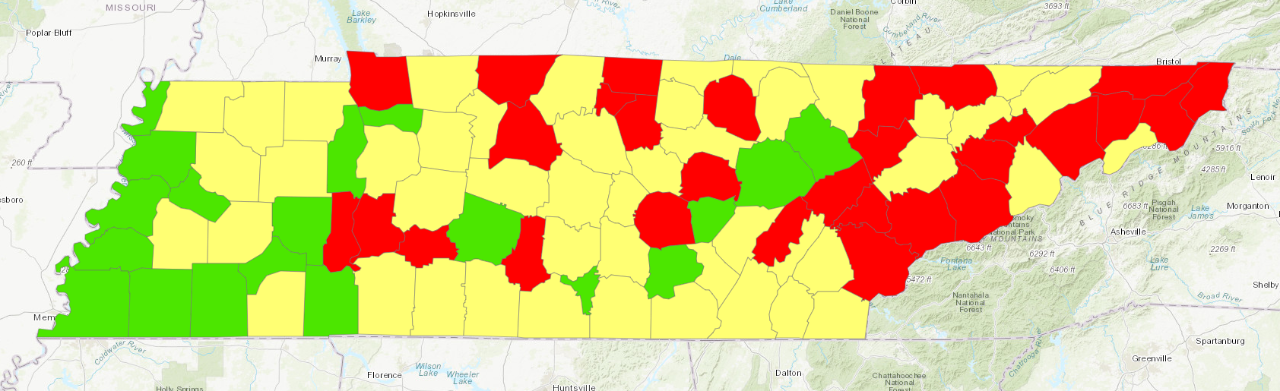
Radon Levels by County
While elevated levels of radon are more prevalent in East Tennessee, levels requiring immediate action have been detected in all counties.
Free Radon Test Kits
Each year, the Tennessee Radon Program distributes approximately 6,000 free test kits to Tennessee residents. Click the button below to order your free radon test kit.
Common Mistakes
Before starting your radon test, carefully read the instructions included with your kit. Our lab often sees common mistakes related to the duration of the test and the speed of its return.
To ensure accurate results, follow these tips:
- Run the test for 3 to 5 days only
- Set a reminder to remove the test at the right time
- Record the start and end times accurately
- Mail the kit back immediately after the test ends (postage is prepaid)
Reducing Radon Levels
If you’ve tested your home and found high levels of radon, it’s important to take action to reduce your risk. U.S. Environmental Protection Agency recommends taking action if indoor radon levels are between 2 and 4 picocuries per liter (pCi/L), and immediate action if levels exceed 4 pCi/L.
The most effective way to lower radon levels is by hiring a certified radon mitigation professional. To find qualified experts in your area, visit the National Radon Proficiency Program (NRPP) Professional Search or the National Radon Safety Board (NRSB) Professional Directory. These directories list certified professionals who can help you make your home safer.
Radon Professionals
The TN Radon Program contracts with Kansas State University, a national leader in radon services, to provide in-state training classes for professionals related to both radon measurement and radon mitigation. To learn more about upcoming training opportunities, call the Tennessee Radon Program Hotline at 1-800-232-1139.
Radon Hotline
Need information or assistance?
1-800-232-1139
Contacts

Chris Pianta
Community Programs Manager
Office of Environmental Stewardship
TDEC.Radon@tn.gov
(615) 532 0738
Brandi Bomar-Moody
Environmental Scienctist
Office of Environmental Stewardship
TDEC.Radon@tn.gov
615-289-1531

Kelsey Davis
Community Programs Manager
Office of Environmental Stewardship
TDEC.Radon@tn.gov
615-289-1531